Sunday, 1 September 2019

IELTS Reading 01-09-2019: Reading Passage 3 (General)

Robots at work


You are advised to spend 20 minutes on Questions 27-40.

Questions 27-32:

The following Reading Passage has seven paragraphs (A-G). Choose the most suitable headings for paragraphs A-B and D-G from the list of headings below.
Write the appropriate numbers (i-ix) in boxes 27-32 on your answer sheet.
NB There are more headings than paragraphs: so you will not use all of them.

List of Headings

i  Robots working together
ii  Preparing LGVs for take-over
iii  Looking ahead
iv The LGVs' main functions
v  Split location for newspaper production
vi Newspapers superseded by technology
vii Getting the newspaper to the printing centre
viii Controlling the robots
ix Beware of robots!
Example                               Answer
Paragraph C                              ix

27. Paragraph  A
28. Paragraph  B
29. Paragraph  D
30. Paragraph  E
31. Paragraph  F
32. Paragraph  G

ROBOTS AT WORK

A
The newspaper production process has come a long way from the old days when the paper was written, edited, typeset and ultimately printed in one building with the journalists working on the upper floors and the printing presses going on the ground floor. These days the editor, subeditors and journalists who put the paper together are likely to find themselves in a totally different building or maybe even in a different city. This is the situation which now prevails in Sydney. The daily paper is compiled at the editorial headquarters, known as the prepress centre, in the heart of the city, but printed far away in the suburbs at the printing centre. Here human beings are in the minority as much of the work is done by automated machines controlled by computers.
B
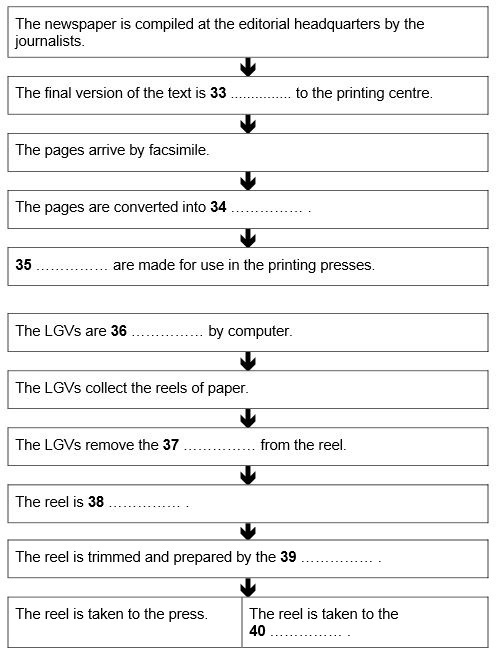
Once the finished newspaper has been created for the next morning’s edition, all the pages are transmitted electronically from the prepress centre to the printing centre. The system of transmission is an update on the sophisticated page facsimile system already in use in many other newspapers. An imagesetter at the printing centre delivers the pages as films. Each page takes less than a minute to produce, although for colour pages four versions, once each for black, cyan, magenta and yellow are sent. The pages are then  processed into photographic negatives and the film is used to produce aluminium printing plates ready for the presses.

C
A procession of automated vehicles is busy at the new printing centre where the Sydney Morning Herald is printed each day. With lights flashing and warning horns honking, the robots (to give them their correct name, the LGVs or laser guided vehicles) look for all the world like enthusiastic machines from a science fiction movie, as they follow their own random paths around the plant busily getting on with their jobs. Automation of this kind is now standard in all modern newspaper plants. The robots can detect unauthorised personnel and alert security staff immediately if they find an “intruder”; not surprisingly, tall tales are already being told about the machines starting to take on personalities of their own.

D
The robots’ principal job, however, is to shift the newsprint (the printing paper) that arrives at the plant in huge reels and emerges at the other end sometime later as newspapers. Once the size of the day’s paper and the publishing order are determined at head office, the information is punched into the computer and the LGVs are programmed to go about their work. The LGVs collect the appropriate size paper reels and take them where they have to go. When the press needs another reel its computer alerts the LGV system. The Sydney LGVs move busily around the press room fulfilling their two key functions to collect reels of newsprint either from the reel stripping stations or from the racked supplies in the newsprint storage area. At the stripping station, the tough wrapping that helps to protect a reel of paper from rough handling is removed. Any damaged paper is peeled off and the reel is then weighed.
E
Then one of the four paster-robots moves in. Specifically designed for the job, it trims the paper neatly and prepares the reel for the press. If required the reel can be loaded directly onto the press; if not needed immediately, an LGV takes it to the storage area. When the press computer calls for a reel, an LGV takes it to the reel loading area of the presses. It lifts the reel into the loading position and places it in the correct spot with complete accuracy. As each reel is used up, the press drops the heavy cardboard core into a waste bin. When the bin is full, another LGV collects it and deposits the cores into a shredder for recycling.

F
The LGVs move at walking speed. Should anyone step in front of one or get too close, sensors stop the vehicle until the path is clear. The company has chosen a laser guide function system for the vehicles because, as the project development manager says “The beauty of it is that if you want to change the routes, you can work out a new route on your computer and lay it down for them to follow”. When an LGV’s batteries run low, it will take itself offline and go to the nearest battery maintenance point for replacement batteries. And all this is achieved with absolute minimum human input and a much reduced risk of injury to people working in the printing centres.
G
The question newspaper workers must now ask, however, is, “how long will it be before the robots are writing the newspapers as well as running the printing centre, churning out the latest edition every morning?”

Questions 33 - 40

Using the information in the passage, complete the flow-chart below.
Write your answers in boxes 33-40 on your answer sheet.
Choose NO MORE THAN THREE WORDS from the passage for each answer.

The Production Process
GT Reading Test 3 Section 3 - Robots at work
Answer:
27. v
28. vii
29. iv
30. i
31. viii
32. iii
33. transmitted (NOT sent) (electronically)
34. (photographic) film// negative(s)
35. (aluminium) printing plates
36. programmed
37. (tough) wrapping // damaged paper
38. weighed
39. paster robot(s)
40. storage area

IELTS Reading 01-09-2019: Reading Passage 2 (General)

Personal Computers & Atlas English Language College


You are advised to spend 20 minutes on Questions 14-26.

Questions 14-20:

Read the passage about personal computers below and look at the statements below (Questions 14-20).

In boxes 14-20 on your answer sheet write-

TRUE    if the statement is true
FALSE    if the statement is false
NOT GIVEN    if the information is not given in the passage

14.  There are two computers and two printers available for public use at the library.
15.  You can buy floppy disks at the information desk.
16.  The information desk is closed at weekends.
17.  It is essential to reserve a computer three days in advance if you want to use one.
18.  If you are more than a quarter of an hour late, you could lose your reservation for the computer.
19.  Library employees do not have detailed knowledge of computers.
20.  The library runs courses for people who want to learn about computers.

PERSONAL COMPUTERS AVAILABLE FOR PUBLIC TO USE

• 2 personal computers are available, for a fee of $5.00. There is also an ink jet printer attached to each terminal. The library has a number of commercially available programs for word processing and spreadsheets.
• A4 paper can be bought from the desk if you wish to print your work. Alternatively, you can bring your own paper. If you wish to store information, however, you will need to bring your own floppy disk.
Bookings
Because of high demand, a maximum of one hour's use per person per day is permitted. Bookings may be made up to three days in advance. Bookings may be made in person at the information desk or by phoning 8673 8901 during normal office hours. If for some reason you cannot keep your appointment, please telephone. If the library is not notified and you are 15 minutes late, your time can be given to someone else. Please sign in the visitors' book at the information desk when you first arrive to use the computer.

Please note that staff are not available to train people or give a lot of detailed instruction on how to use the programs. Prior knowledge is, therefore, necessary. However, tutorial groups are available for some of the programs and classes are offered on a regular basis. Please see the loans desk for more information about our computer courses.

Questions 21-26

The text on Atlas English Language College has seven paragraphs (A-G).
Choose the most suitable headings for paragraphs B-G from the list of headings below.
Write the appropriate numbers (i-ix) in boxes 21-26 on your answer sheet.
NB There are more headings than paragraphs, so you will not use all of them.

List of Headings

i  Recognition of your achievements
ii  Courses start every week
iii  Other services/Pastoral care/Personal arrangements
iv  A personal approach
v  Two meals every day
vi  First-class staff
vii  Up-to-date classroom practice
viii  Discovering a new language
ix  Monitored achievement
21  Paragraph  B
22 Paragraph  C
23  Paragraph  D
24  Paragraph  E
25  Paragraph  F
26  Paragraph  G

GOOD REASONS FOR CHOOSING 
ATLAS ENGLISH LANGUAGE COLLEGE

On an English course with Atlas English Language College, you improve your language skills and make friends from all over the world!

A Because Atlas courses start every Monday of the year, there's bound to be one that fits in with your academic, personal or professional commitments. Whatever your level of language ability, from beginner to advanced, you can choose to study for any length of time, from two weeks to a full year. Courses match a range of individual requirements, from intensive examination preparation to short summer programmes. Most courses commence at 9 am and run till 3 pm.

B If you take an intensive full-time course, we will help you to select the Special Interest Options which best suit your goals. From then on, our teacher will discuss your work with you on a weekly basis. This means that you should develop the language skills you need and that you are helped to study at your own pace.

C The popularity and success of any language school depend greatly on the quality of the teachers and the methods they employ. All Atlas teachers have specialist qualifications in the teaching of English to foreign students and are all native speakers. We employ only experienced professionals with a proven record of success in the classroom.

D Atlas's teaching methodology is constantly revised as more is discovered about the process of learning a new language. Our teachers have access to an extensive range of materials, including the very latest in language teaching technology.

E On your first day at school, you will take a test which enables our Director of Studies to place you at the appropriate study level. Your progress will be continuously assessed and, once you have achieved specific linguistic goals, you will move up to a higher level of study.

F Every Atlas course fee includes accommodation in carefully selected homestay families. Breakfast and dinner each day are also included, so you need have no concerns about having to look for somewhere to live once you get to the school.

G On completion of any Intensive, Examination or Summer course, you will receive the Atlas Course Certificate of Attendance. On completion of a four-week course or longer, you will also receive the Atlas Academic Record that reflects your ability in every aspect of the language from conversation to writing. Such a record will allow you to present your linguistic credentials to academic institutions or potential employers around the world.

[adapted with permission from a brochure published by EF Education]
Answer:
14. TRUE
15. FALSE
16. NOT GIVEN
17. FALSE
18. TRUE
19. NOT GIVEN
20. TRUE
21. iv
22. vi
23. vii
24. ix
25. iii
26. i

IELTS Reading 01-09-2019: Reading Passage 1 (General)

Dining Out & Electricity Account Payment


You are advised to spend 20 minutes on Questions 1-13.

Questions 1-7:

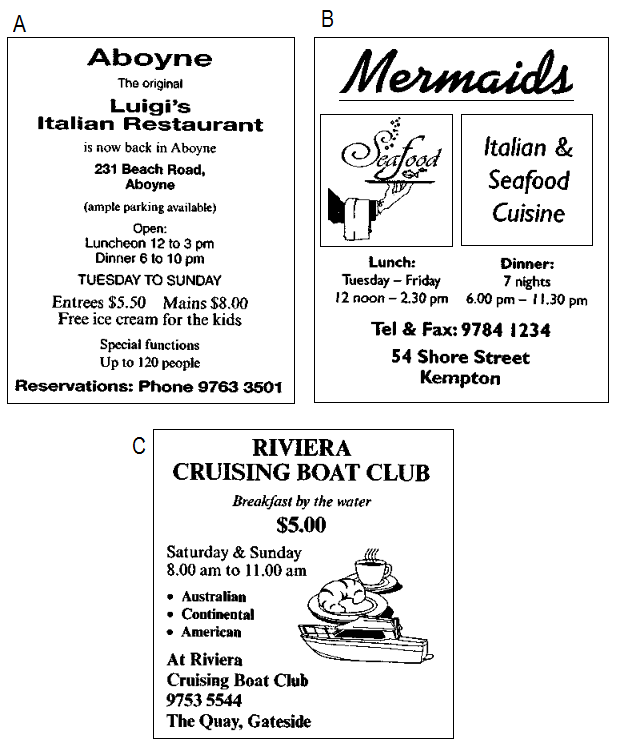
Look at the three restaurant advertisements below. Answer the questions below by writing the letters of the appropriate restaurants (A-C) in boxes 1-7 on your answer sheet.

Example                                                   Answer

It stops serving lunch at 2.30 pm.                  B         
1. It is open for breakfast.
2. It is open every night for dinner.
3. It is only open for lunch on weekdays.
4. It has recently returned to its previous location.
5. It welcomes families.
6. It caters for large groups.
7. It only opens at weekends.

D I N I N G   O U T

Dining Out- Restaurant advertisements

Questions 8-13:

Read the information given in 'New Electricity Account Payment Facilities' below and look at the statements (Questions 8-13).
In boxes 8-13 on your answer sheet write:

TRUE            if the statement is true
FALSE          if the statement is false
NOT GIVEN if the information is not given in the passage
Example                                                          Answer

You must pay your account by mail.                  FALSE
 8.  If you want a receipt, you should send your payment to the Southport address.
 9.  You may pay your account at branches of the Federal Bank.
10. You must pay the full amount, instalments are not permitted.
11. The Coastside Power Office is open on Saturday mornings.
12. You may pay your account by phone using your credit card.
13. There is a reduction for prompt payment.

NEW ELECTRICITY ACCOUNT PAYMENT FACILITIES
AVAILABLE FROM' JULY 1998

After 1 July 1998, you may pay your electricity account in any of the following ways:
1. Payments via mail:

                (A) No receipt required:
                      Mail payments to:
                                                    Coastside Power
                                                    Locked Bag 2760
                                                    Southport NSW 3479

                (B) Receipt required:
                      Mail payments to:
                                                   Coastside Power
                                                   PO Box 560
                                                   Northbridge NSW 3472
2. Agency payments (payments directly to the bank): 
Payments can be made at any branch of the Federal Bank by completing the deposit slip attached to your account notice.
NB: This facility is no longer available at South Pacific Bank branches.
3. Payments directly to Coastside Power Office: 
Payments can be made directly to Coastside Power Office at 78-80 Third Avenue, Northbridge. Office hours are Monday to Friday, 8.30 am to 4.30 pm.
Payment may be by personal cheque, bank cheque or cash.
Note: Payments cannot be made by phone.

Answer:
1. C
2. B
3. B
4. A
5. A
6. A
7. C
8. FALSE
9. TRUE
10. NOT GIVEN
11. FALSE
12. FALSE
13. NOT GIVEN

IELTS Reading 01-09-2019: Reading Passage 3 (Academic)

You should spend about 20 minutes on Questions 27-38 which are based on Reading Passage 4 below.

A Workaholic Economy

For the first century or so of the industrial revolution, increased productivity led to decreases in working hours. Employees who had been putting in 12-hour days, six days a week, found their time on the job shrinking to 10 hours daily, then finally to eight hours, five days a week. Only a generation ago social planners worried about what people would do with all this new-found free time. In the US, at least it seems they need not have bothered.
Although the output per hour of work has more than doubled since 1945, leisure seems reserved largely for the unemployed and underemployed. Those who work full-time spend as much time on the job as they did at the end of World War II. In fact, working hours have increased noticeably since 1970 — perhaps because real wages have stagnated since that year. Bookstores now abound with manuals describing how to manage time and cope with stress.
There are several reasons for lost leisure. Since 1979, companies have responded to improvements in the business climate by having employees work overtime rather than by hiring extra personnel, says economist Juliet B. Schor of Harvard University. Indeed, the current economic recovery has gained a certain amount of notoriety for its “jobless” nature: increased production has been almost entirely decoupled from employment. Some firms are even downsizing as their profits climb. “All things being equal, we'd be better off spreading around the work," observes labour economist Ronald G. Ehrenberg of Cornell University.
Yet a host of factors pushes employers to hire fewer workers for more hours and at the same time compels workers to spend more time on the job. Most of those incentives involve what Ehrenberg calls the structure of compensation: quirks in the way salaries and benefits are organised that make it more profitable to ask 40 employees to labour an extra hour each than to hire one more worker to do the same 40-hour job.
Professional and managerial employees supply the most obvious lesson along these lines. Once people are on salary, their cost to a firm is the same whether they spend 35 hours a week in the office or 70. Diminishing returns may eventually set in as overworked employees lose efficiency or leave for more arable pastures. But in the short run, the employer’s incentive is clear. Even hourly employees receive benefits - such as pension contributions and medical insurance - that are not tied to the number of hours they work. Therefore, it is more profitable for employers to work their existing employees harder.
For all that employees complain about long hours, they too have reasons not to trade money for leisure. “People who work reduced hours pay a huge penalty in career terms,” Schor maintains. “It's taken as a negative signal’ about their commitment to the firm.’ [Lotte] Bailyn [of Massachusetts Institute of Technology] adds that many corporate managers find it difficult to measure the contribution of their underlings to a firm’s well-being, so they use the number of hours worked as a proxy for output. “Employees know this,” she says, and they adjust their behaviour accordingly.
“Although the image of the good worker is the one whose life belongs to the company,” Bailyn says, “it doesn't fit the facts.’ She cites both quantitative and qualitative studies that show increased productivity for part-time workers: they make better use of the time they have and they are less likely to succumb to fatigue in stressful jobs. Companies that employ more workers for less time also gain from the resulting redundancy, she asserts. "The extra people can cover the contingencies that you know are going to happen, such as when crises take people away from the workplace." Positive experiences with reduced hours have begun to change the more-is-better culture at some companies, Schor reports.
Larger firms, in particular, appear to be more willing to experiment with flexible working arrangements...
It may take even more than changes in the financial and cultural structures of employment for workers successfully to trade increased productivity and money for leisure time, Schor contends. She says the U.S. market for goods has become skewed by the assumption of full-time, two-career households. Automobile makers no longer manufacture cheap models, and developers do not build the tiny bungalows that served the first postwar generation of home buyers. Not even the humblest household object is made without a microprocessor. As Schor notes, the situation is a curious inversion of the “appropriate technology” vision that designers have had for developing countries: U.S. goods are appropriate only for high incomes and long hours. --- Paul Walluh.
Questions 27-32
Do the following statements agree with the views of the writer in reading passage 4? In boxes 27-32 on your answer sheet write:
YES              if the statement agrees with the writer
NO                if the statement contradicts the writer
NOT GIVEN  if it is impossible to say what the writer thinks about this
  Example                                                                                                             Answer
During the industrial revolution, people worked harder                           NOT GIVEN
27    Today, employees are facing a reduction in working hours.
28    Social planners have been consulted about US employment figures.
29    Salaries have not risen significantly since the 1970s.
30    The economic recovery created more jobs.
31    Bailyn’s research shows that part-time employees work more efficiently.
32    Increased leisure time would benefit two-career households.

Questions 33-34
Choose the appropriate letters A-D and write them in boxes 33 and 34 on your answer sheet.
33 Bailyn argues that it is better for a company to employ more workers because
      A.    it is easy to make excess staff redundant.
      B.    crises occur if you are under-staffed.
      C.    people are available to substitute for absent staff.
      D.    they can project a positive image at work.
34 Schor thinks it will be difficult for workers in the US to reduce their working hours because
      A.    they would not be able to afford cars or homes.
      B.    employers are offering high incomes for long hours.
      C.    the future is dependent on technological advances.
      D.    they do not wish to return to the humble post-war era.
Questions 35-38
The writer mentions a number of factors that have resulted, in employees working longer hours. Which FOUR of the following factors are mentioned? Write your answers (A-H) in boxes 35-38 on your answer sheet.
List of Factors
A   Books are available to help employees cope with stress.
B   Extra work is offered to existing employees.
C   Increased production has led to joblessness.
D   Benefits and hours spent on the job are not linked.
E   Overworked employees require longer to do their work.
F    Longer hours indicate a greater commitment to the firm.
G   Managers estimate staff productivity in terms of hours worked.
H   Employees value a career more than a family.
 
Answer:
27. No
28. Not Given
29. Yes
30. No
31. Yes
32. Not Given
33. C
34. A
35. B. (Extra work is offered to existing employees.)
36. D. (Benefits and hours spent on the job are not linked)
37. F. (Longer hours indicate greater commitment to the firm.)
38. G. (Managers estimate staff productivity in terms of hours worked.)

[Answer 35 - 38, in any order] 
 

IELTS Reading 01-09-2019: Reading Passage 1 (Academic)

You should spend about 20 minutes on Questions 1-13 which are based on Reading Passage 6 below.

 A Remarkable Beetle

Some of the most remarkable beetles are the dung beetles, which spend almost their whole lives eating and breeding in dung’.
ielts reading 6More than 4,000 species of these remarkable creatures have evolved and adapted to the world’s different climates and the dung of its many animals. Australia’s native dung beetles are scrub and woodland dwellers, specialising in coarse marsupial droppings and avoiding the soft cattle dung in which bush flies and buffalo flies breed.
In the early 1960s George Bornemissza, then a scientist at the Australian Government’s premier research organisation, the Commonwealth Scientific and Industrial Research Organisation (CSIRO), suggested that dung beetles should be introduced to Australia to control dung-breeding flies. Between 1968 and 1982, the CSIRO imported insects from about 50 different species of dung beetle, from Asia, Europe and Africa, aiming to match them to different climatic zones in Australia. Of the 26 species that are known to have become successfully integrated into the local environment, only one, an African species released in northern Australia, has reached its natural boundary.
Introducing dung beetles into a pasture is a simple process: approximately 1,500 beetles are released; a handful at a time, into fresh cow pats 2 in the cow pasture. The beetles immediately disappear beneath the pats digging and tunnelling and, if they successfully adapt to their new environment, soon become a permanent, self-sustaining part of the local ecology. In time they multiply and within three or four years the benefits to the pasture are obvious.
Dung beetles work from the inside of the pat so they are sheltered from predators such as birds and foxes. Most species burrow into the soil and bury dung in tunnels directly underneath the pats, which are hollowed out from within. Some large species originating from France excavate tunnels to a depth of approximately 30 cm below the dung pat. These beetles make sausage-shaped brood chambers along the tunnels. The shallowest tunnels belong to a much smaller Spanish species that buries dung in chambers that hang like fruit from the branches of a pear tree. South African beetles dig narrow tunnels of approximately 20 cm below the surface of the pat. Some surface-dwelling beetles, including a South African species, cut perfectly-shaped balls from the pat, which are rolled away and attached to the bases of plants.
For maximum dung burial in spring, summer and autumn, farmers require a variety of species with overlapping periods of activity. In the cooler environments of the state of Victoria, the large French species (2.5 cms long) is matched with smaller (half this size), temperate-climate Spanish species. The former are slow to recover from the winter cold and produce only one or two generations of offspring from late spring until autumn. The latter, which multiplies rapidly in early spring, produce two to five generations annually. The South African ball-rolling species, being a subtropical beetle, prefers the climate of northern and coastal New South Wales where it commonly works with the South African tunnelling species. In warmer climates, many species are active for longer periods of the year.
Dung beetles were initially introduced in the late 1960s with a view to controlling buffalo flies by removing the dung within a day or two and so preventing flies from breeding. However, other benefits have become evident. Once the beetle larvae have finished pupation, the residue is a first-rate source of fertiliser. The tunnels abandoned by the beetles provide excellent aeration and water channels for root systems. In addition, when the new generation of beetles has left the nest the abandoned burrows are an attractive habitat for soil-enriching earthworms. The digested dung in these burrows is an excellent food supply for the earthworms, which decompose it further to provide essential soil nutrients. If it were not for the dung beetle, chemical fertiliser and dung would be washed by rain into streams and rivers before it could be absorbed into the hard earth, polluting water courses and causing blooms of blue-green algae. Without the beetles to dispose of the dung, cow pats would litter pastures making grass inedible to cattle and depriving the soil of sunlight. Australia’s 30 million cattle each produce 10-12 cow pats a day. This amounts to 1.7 billion tonnes a year, enough to smother about 110,000 sq km of pasture, half the area of Victoria.
Dung beetles have become an integral part of the successful management of dairy farms in Australia over the past few decades. A number of species are available from the CSIRO or through a small number of private breeders, most of whom were entomologists with the CSIRO’s dung beetle unit who have taken their specialised knowledge of the insect and opened small businesses in direct competition with their former employer.
Glossary
  1.  dung:- the droppings or excreta of animals
  2.  cow pats:- droppings of cows
Questions 1-5
Do the following statements reflect the claims of the writer in Reading Passage 6? In boxes 1-5 on your answer sheet write:
         YES              if the statement reflects the claims of the writer
         NO                if the statement contradicts the claims of the writer
         NOT GIVEN   if it is impossible to say what the writer thinks about this
1       Bush flies are easier to control than buffalo flies.
2       Four thousand species of dung beetle were initially brought to Australia by the CSIRO.
3       Dung beetles were brought to Australia by the CSIRO over a fourteen-year period.
4       At least twenty-six of the introduced species have become established in Australia.
5       The dung beetles cause an immediate improvement to the quality of a cow pasture.

Questions 6-8
Label the tunnels on the diagram below. Choose your labels from the box below the diagram. Write your answers in boxes 6-8 on your answer sheet.
Write your answers in boxes 6-8 on your answer sheet.
IELTS Academic Reading Sample 6
Dung Beetle Types

French                      Spanish
Mediterranean           South African
Australian native        South African ball roller.
Question 9-13
Complete the table below.
Choose NO MORE THAN THREE WORDS OR A NUMBER from Reading Passage 6 for each answer.
Write your answers in boxes 9—13 on your answer sheet.
Species
Size
Preferred
Climate
Complementary
species
Start of
active period
Number of
generations
per  year
French
2.5 cm
Cool
Spanish
Late spring
1-2
Spanish
1.25 cm
9

10
1
South African ball roller

12
13


Answer:
1. NOT GIVEN   2. NO   3. YES  4. YES  5. NO  6. South African  7. French   8. Spanish   9. temperate   10. early spring   11. two to five / 2-5   12. sub-tropical   13. South African tunneling/tunnelling

Contributors

Nature Beauty | Water | Road | River