Monday, 2 September 2019

IELTS Reading 02-09-2019: Reading Passage 1 (General)

Some places to visit & LearnWithUs courses


Read the text below and answer Questions 1-8.

Some places to visit

A    Beautiful Kingsley House was built in the 18th century, and all the rooms are decorated and furnished in the style of the time. They include the dining room, study and dressing room, which contains a display of 18th-century ladies’ clothing. Our volunteer guides in each room bring the house to life with stories of the past.

B    The Africa Museum was founded 50 years ago, and to commemorate the event, we have chosen 50 treasures from the permanent collection and put them together to tell the fascinating story of that continent. This exhibition continues until the end of the year. The Folk Art Gallery opens to the public next month, exhibiting traditional paintings and other objects from all over Africa.

C    From the outside, 17 Mansfield Street may not look particularly exciting, but come inside, and you’ll find yourself in a historic building that started life as a theatre, before becoming a bank and then a restaurant, which is still in operation. On
Sundays and Mondays, when the restaurant is closed, a guide is available to show you round the building and its fascinating architectural features.

D    The Industrial Heritage Centre tells the fascinating story of a local family firm. Mr John Carroll started his engineering business in this building exactly 150 years ago. The firm closed in 1969, but the factory has been re-created, with machines like those that Mr Carroll was familiar with. See what working life could be like in the 19th century, a life far removed from the elegance of the wealthy.

E    The Fashion Museum has only just opened. It is home to an outstanding collection of more than 30,000 objects worn by men, women and children, dating from the 17th century to the present day. You’ll see how people used to dress! As well as
the permanent exhibits, you can currently see Dressing the Stars, which displays original costumes worn by the stars of many popular films.

F     Having spent the best part of two years being refurbished, the Mason Museum has recently opened its doors again. It provides a magnificent setting for its art collection and for the beautiful 18th-century furniture for which the Mason is famous. Open Mondays to Fridays 10-4, and weekends 10-6.

Questions 1-8

The text above has six descriptions of places to visit in the same city, A-F.

Which description mentions the following information?


Write the correct letter A-F, in boxes 1-8 on your answer sheet.

NB You may use any letter more than once.

1. clothes that well-known people have worn
2. a display that cannot be seen yet
3. people who talk in an entertaining way
4. the museum having just reopened
5. a building that has changed its function several times
6. furniture of the same kind that was used when the building was new
7. being open for tours on certain days of the week
8. a special event to mark an anniversary


Read the text below and answer Questions 9-14.

LearnWithUs courses

LearnWithlls courses are a great way to learn, because they’re so flexible. All our courses are taken online using a computer, so you can work through the course at your own speed, and go back to any session whenever you want to. For some courses there are workbooks, in addition to the computer course, to provide extra written practice.

We offer hundreds of courses in a whole range of subjects from reading, writing and maths to business and management. Many of these are specially designed for people whose first language isn’t English.

Step one: have a chat with a friendly member of staff in one of our 1,500 LearnWithUs centres around the country. They can advise you on the most suitable course. They’ll also work out whether you qualify for funding, so that you won’t have to pay the full fee for the course.

You might want to try a taster lesson first. This is a single computer session in any subject of your choice, and it will show you what learning with LearnWithUs is like.

When you’ve made your final decision, step two is to register on your course. Once you’ve done this, a staff member will show you how to get started, whether you’re using a computer at home, at work or at a LearnWithUs centre.

That’s all you need to do! When you start your course, you can contact your LearnWithUs centre by phone (we’re open during normal office hours) or email if you need help.

Questions 9-14

Do the following statements agree with the information given in the text above?

In boxes 9-14 on your answer sheet, write

TRUE   if the statement agrees with the information
FALSE   if the statement contradicts the information
NOT GIVEN   if there is no information on this

9. You can work through parts of a course more than once.
10. The number of courses offered by LearnWithUs has increased enormously.
11. Many staff members have worked through a LearnWithUs course themselves.
12. You may have to pay to take a LearnWithUs course.
13. Everybody takes the same taster lesson.
14. LearnWithUs centres are open seven days a week.
 Answer:
1. E
2. B
3. A
4. F
5. C
6. A
7. C
8. B
9. TRUE
10. NOT GIVEN
11. NOT GIVEN
12. TRUE
13. FALSE
14. FALSE

IELTS Reading 02-09-2019: Reading Passage 3 (Academic)

You should spend about 20 minutes on Questions 30-41 which are based on the Reading Passage below.

PAPER RECYCLING

A Paper is different from other waste produce because it comes from a sustainable resource: trees. Unlike the minerals and oil used to make plastics and metals, trees are replaceable. Paper is also biodegradable, so it does not pose as much threat to the environment when it is discarded. While 45 out of every 100 tonnes of wood fibre used to make paper in Australia comes from waste paper, the rest comes directly from virgin fibre from forests and plantations. By world standards, this is a good performance since the worldwide average is 33 percent waste paper. Governments have encouraged waste paper collection and sorting schemes and at the same time, the paper industry has responded by developing new recycling technologies that have paved the way for even greater utilization of used fibre. As a result, industry’s use of recycled fibres is expected to increase at twice the rate of virgin fibre over the coming years.
B Already, waste paper constitutes 70% of paper used for packaging and advances in the technology required to remove ink from the paper have allowed a higher recycled content in newsprint and writing paper. To achieve the benefits of recycling, the community must also contribute. We need to accept a change in the quality of paper products; for example, stationery may be less white and of a rougher texture. There also needs to support from the community for waste paper collection programs. Not only do we need to make the paper available to collectors but it also needs to be separated into different types and sorted from contaminants such as staples, paperclips, string and other miscellaneous items.
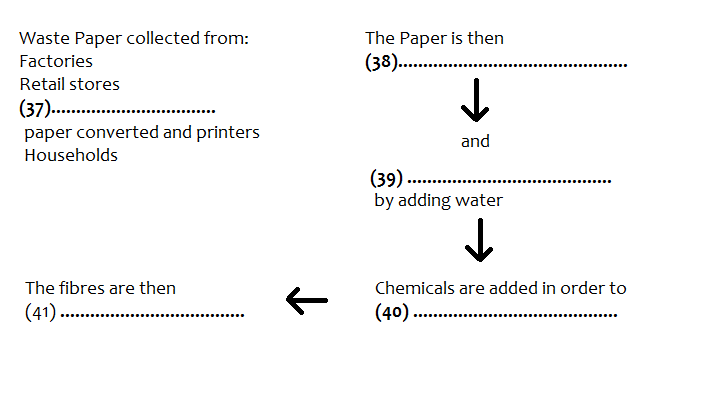
C There are technical limitations to the amount of paper which can be recycled and some paper products cannot be collected for re-use. These include paper in the form of books and permanent records, photographic paper and paper which is badly contaminated. The four most common sources of paper for recycling are factories and retail stores which gather large amounts of packaging material in which goods are delivered, also offices which have unwanted business documents and computer output, paper converters and printers and lastly households which discard newspapers and packaging material. The paper manufacturer pays a price for the paper and may also incur the collection cost.
D Once collected, the paper has to be sorted by hand by people trained to recognise various types of paper. This is necessary because some types of paper can only be made from particular kinds of recycled fibre. The sorted paper then has to be repulped or mixed with water and broken down into its individual fibres. This mixture is called stock and may contain a wide variety of contaminating materials, particularly if it is made from mixed waste paper which has had little sorting. Various machineries are used to remove other materials from the stock. After passing through the repulping process, the fibres from printed waste paper are grey in colour because the printing ink has soaked into the individual fibres. This recycled material can only be used in products where the grey colour does not matter, such as cardboard boxes but if the grey colour is not acceptable, the fibres must be de-inked. This involves adding chemicals such as caustic soda or other alkalis, soaps and detergents, water-hardening agents such as calcium chloride, frothing agents and bleaching agents. Before the recycled fibres can be made into paper they must be refined or treated in such a way that they bond together.
E Most paper products must contain some virgin fibre as well as recycled fibres and unlike glass, paper cannot be recycled indefinitely. Most paper is down-cycled which means that a product made from recycled paper is of an inferior quality to the original paper. Recycling paper is beneficial in that it saves some of the energy, labour and capital that go into producing virgin pulp. However, recycling requires the use of fossil fuel, a non-renewable energy source, to collect the waste paper from the community and to process it to produce new paper. And the recycling process still creates emissions which require treatment before they can be disposed of safely. Nevertheless, paper recycling is an important economical and environmental practice but one which must be carried out in a rational and viable manner for it to be useful to both industry and the community.
Questions 30-36
Complete the summary below of the first two paragraphs of the Reading Passage.
Choose ONE OR TWO WORDS from the Reading Passage for each answer.
Write your answers in boxes 30-36 on your answer sheet.
SUMMARY
Example ....
From the point of view of recycling, paper has two advantages over minerals and ...........oil..........
in that firstly it comes from a resource which is ........ (30) ........ and secondly, it is less threatening to our environment when we throw it away because it is ....... (31) ...... Although Australia’s record in the re-use of waste paper is good, it is still necessary to use a combination of recycled fibre and ........ (32) ........ to make new paper. The paper industry has contributed positively and people have also been encouraged by .........(33) ......... to collect their waste on a regular basis. One major difficulty is the removal of ink from used paper but ......... (34) ......... are being made in this area. However, we need to learn to accept paper which is generally of a lower ......... (35) ......... than before and to sort our waste paper by removing ......... (36) ........ before discarding it for collection.
Look at paragraphs C, D, and E and, using the information in the passage, complete the flow chart below. Write your answers in boxes 37-41 on your answer sheet. Use ONE OR TWO WORDS for each answer.

IELTS Academic reading sample 9
Answer:
30.     sustamable  31.     biodegradable    32.     virgin fibre/ pulp   33.     governments/ the government    34.     advances   35.     quality    36.     contaminants   37.     offices   38.     sorted    39.     (re)pulped   40.     de-ink/ remove ink/ make white   41.     refined
 

IELTS Reading 02-09-2019: Reading Passage 2 (Academic)

You should spend about 20 minutes on Questions 14-27 which are based on Reading Passage sample 8 below.

Questions 14-18
Reading passage 8 has six paragraphs B-F from the list of headings below Choose the most suitable headings for paragraphs B-F from the list of headings below.
Write the appropriate numbers (i-ix) in boxes 14-18 on your answer sheet.

NB There are more headings than paragraphs, so you will not use them all.

 List of Headings
 i)    Ottawa International Conference on Health Promotion
 ii)    Holistic approach to health
 iii)   The primary importance of environmental factors
 iv)   Healthy lifestyles approach to health
 v)    Changes in concepts of health in Western society
 vi)   Prevention of diseases and illness
 vii)  Ottawa Charter for Health Promotion
 viii)  Definition of health in medical terms
  ix)  Socio-ecological view of health
14.    Paragraph   B
15.    Paragraph   C
16.    Paragraph   D
17.    Paragraph   E
18.    Paragraph   F

Changing Our Understanding of Health

A
The concept of health holds different meanings for different people and groups. These meanings of health have also changed over time. This change is no more evident than in Western society today, when notions of health and health promotion are being challenged and expanded in new ways.

B
For much of recent Western history, health has been viewed in the physical sense only. That is, good health has been connected to the smooth mechanical operation of the body, while ill health has been attributed to a breakdown in this machine. Health in this sense has been defined as the absence of disease or illness and is seen in medical terms. According to this view, creating health for people means providing medical care to treat or prevent disease and illness. During this period, there was an emphasis on providing clean water, improved sanitation and housing.

C
In the late 1940s the World Health Organisation challenged this physically and medically oriented view of health. They stated that 'health is a complete state of physical, mental and social well-being and is not merely the absence of disease' (WHO, 1946). Health and the person were seen more holistically (mind/body/spirit) and not just in physical terms.

D
The 1970s was a time of focusing on the prevention of disease and illness by emphasising the importance of the lifestyle and behaviour of the individual. Specific behaviours which were seen to increase the risk of diseases, such as smoking, lack of fitness and unhealthy eating habits, were targeted. Creating health meant providing not only medical health care, but health promotion programs and policies which would help people maintain healthy behaviours and lifestyles. While this individualistic healthy lifestyle approach to health worked for some (the wealthy members of society), people experiencing poverty, unemployment, underemployment or little control over the conditions of their daily lives benefited little from this approach. This was largely because both the healthy lifestyles approach and the medical approach to health largely ignored the social and environmental conditions affecting the health of people.

E
During 1980s and 1990s there has been a growing swing away from seeing lifestyle risks as the root cause of poor health. While lifestyle factors still remain important, health is being viewed also in terms of the social, economic and environmental contexts in which people live. This broad approach to health is called the socio-ecological view of health. The broad socio-ecological view of health was endorsed at the first International Conference of Health Promotion held in 1986, Ottawa, Canada, where people from 38 countries agreed and declared that:
The fundamental conditions and resources for health are peace, shelter, education, food, a viable income, a stable eco-system, sustainable resources, social justice and equity. Improvement in health requires a secure foundation in these basic requirements. (WHO, 1986) .

It is clear from this statement that the creation of health is about much more than encouraging healthy individual behaviours and lifestyles and providing appropriate medical care. Therefore, the creation of health must include addressing issues such as poverty, pollution, urbanisation, natural resource depletion, social alienation and poor working conditions. The social, economic and environmental contexts which contribute to the creation of health do not operate separately or independently of each other. Rather, they are interacting and interdependent, and it is the complex interrelationships between them which determine the conditions that promote health. A broad socio-ecological view of health suggests that the promotion of health must include a strong social, economic and environmental focus.

F
At the Ottawa Conference in 1986, a charter was developed which outlined new directions for health promotion based on the socio-ecological view of health. This charter, known as the Ottawa Charter for Health Promotion, remains as the backbone of health action today. In exploring the scope of health promotion it states that:
Good health is a major resource for social, economic and personal development and an important dimension of quality of life. Political, economic, social, cultural, environmental, behavioural and biological factors can all favour health or be harmful to it. (WHO, 1986) .

The Ottawa Charter brings practical meaning and action to this broad notion of health promotion. It presents fundamental strategies and approaches in achieving health for all. The overall philosophy of health promotion which guides these fundamental strategies and approaches is one of 'enabling people to increase control over and to improve their health' (WHO, 1986).

Questions 19-22
Using NO MORE THAN THREE WORDS from the passage, answer the following questions
Write your answers in boxes 19-22 on your answer sheet.

19. In which year did the World Health Organization define health in terms of mental, physical and social well-being?
20. Which members of society benefited most from the healthy lifestyles approach to health?
21. Name the three broad areas which relate to people's health, according to the socio-ecological view of health.
22. During which decade were lifestyle risks seen as the major contributors to poor health?
 
Questions 23-27
Do the following statements agree with the information in Reading Passage 8?
In boxes 23-27 on your answer sheet write
         YES             if the statement agrees with the information.
         NO               if the statement contradicts the information.
         NOT GIVEN  if there is no information on this in the passage.


23 Doctors have been instrumental in improving living standards in Western society.
24 The approach to health during the 1970s included the introduction of health awareness programs.
25 The socio-ecological view of health recognises that lifestyle habits and the provision of adequate health care are critical factors governing health.
26 The principles of the Ottawa Charter are considered to be out of date in the 1990s.
27  In recent years a number of additional countries have subscribed to the Ottawa Charter.

Answer: 
14. viii
15. ii
16. iv
17. ix
18. vii
19. 1946
20. (the) wealthy (members) (of) (society)
21. social, economic, environmental
22. (the) 1970s
23. NOT GIVEN
24. YES
25. NO
26. NO
27. NOT GIVEN

IELTS Reading 02-09-2019: Reading Passage 1 (Academic)

You should spend about 20 minutes on Questions 1–14 which are based on Reading Passage Sample 7 below:

Alarming Rate of Loss of Tropical Rainforests

Adults and children are frequently confronted with statements about the alarming rate of loss of tropical rainforests. ielts reading sample 7For example, one graphic illustration to which children might readily relate is the estimate that rainforests are being destroyed at a rate equivalent to one thousand football fields every forty minutes – about the duration of a normal classroom period. In the face of the frequent and often vivid media coverage, it is likely that children will have formed ideas about rainforests – what and where they are, why they are important, what endangers them – independent of any formal tuition. It is also possible that some of these ideas will be mistaken. Many studies have shown that children harbour misconceptions about ‘pure’, curriculum science. These misconceptions do not remain isolated but become incorporated into a multifaceted, but organised, conceptual framework, making it and the component ideas, some of which are erroneous, more robust but also accessible to modification. These ideas may be developed by children absorbing ideas through the popular media. Sometimes this information may be erroneous. It seems schools may not be providing an opportunity for children to re-express their ideas and so have them tested and refined by teachers and their peers.
Despite the extensive coverage in the popular media of the destruction of rainforests, little formal information is available about children’s ideas in this area. The aim of the present study is to start to provide such information, to help teachers design their educational strategies to build upon correct ideas and to displace misconceptions and to plan programmes in environmental studies in their schools.

The study surveys children’s scientific knowledge and attitudes to rainforests. Secondary school children were asked to complete a questionnaire containing five open-form questions. The most frequent responses to the first question were descriptions which are self-evident from the term ‘rainforest’. Some children described them as damp, wet or hot. The second question concerned the geographical location of rainforests. The commonest responses were continents or countries: Africa (given by 43% of children), South America (30%), Brazil (25%). Some children also gave more general locations, such as being near the Equator.
Responses to question three concerned the importance of rainforests. The dominant idea, raised by 64% of the pupils, was that rainforests provide animals with habitats. Fewer students responded that rainforests provide plant habitats, and even fewer mentioned the indigenous populations of rainforests. More girls (70%) than boys (60%) raised the idea of the rainforest as animal habitats.

Similarly, but at a lower level, more girls (13%) than boys (5%) said that rainforests provided human habitats. These observations are generally consistent with our previous studies of pupils’ views about the use and conservation of rainforests, in which girls were shown to be more sympathetic to animals and expressed views which seem to place an intrinsic value on non-human animal life.

The fourth question concerned the causes of the destruction of rainforests. Perhaps encouragingly, more than half of the pupils (59%) identified that it is human activities which are destroying rainforests, some personalising the responsibility by the use of terms such as ‘we are’. About 18% of the pupils referred specifically to logging activity.

One misconception, expressed by some 10% of the pupils, was that acid rain is responsible for rainforest destruction; a similar proportion said that pollution is destroying rainforests. Here, children are confusing rainforest destruction with damage to the forests of Western Europe by these factors. While two-fifths of the students provided the information that the rainforests provide oxygen, in some cases this response also embraced the misconception that rainforest destruction would reduce atmospheric oxygen, making the atmosphere incompatible with human life on Earth.

In answer to the final question about the importance of rainforest conservation, the majority of children simply said that we need rainforests to survive. Only a few of the pupils (6%) mentioned that rainforest destruction may contribute to global warming. This is surprising considering the high level of media coverage on this issue. Some children expressed the idea that the conservation of rainforests is not important.

The results of this study suggest that certain ideas predominate in the thinking of children about rainforests. Pupils’ responses indicate some misconceptions in the basic scientific knowledge of rainforests’ ecosystems such as their ideas about rainforests as habitats for animals, plants and humans and the relationship between climatic change and destruction of rainforests.

Pupils did not volunteer ideas that suggested that they appreciated the complexity of causes of rainforest destruction. In other words, they gave no indication of an appreciation of either the range of ways in which rainforests are important or the complex social, economic and political factors which drive the activities which are destroying the rainforests. One encouragement is that the results of similar studies about other environmental issues suggest that older children seem to acquire the ability to appreciate, value and evaluate conflicting views. Environmental education offers an arena in which these skills can be developed, which is essential for these children as future decision-makers.
Questions 1–8
Do the following statements agree with the information given in Reading Sample 7?
In boxes 1–8 on your answer sheet write:
TRUE  if the statement agrees with the information
FALSE  if the statement contradicts the information
NOT GIVEN  if there is no information on this
1 The plight of the rainforests has largely been ignored by the media.
2 Children only accept opinions on rainforests that they encounter in their classrooms.
3 It has been suggested that children hold mistaken views about the ‘pure’ science that they study at school.
4 The fact that children’s ideas about science form part of a larger framework of ideas mean that it is easier to change them.
5 The study involved asking children a number of yes/no questions such as ‘Are there any rainforests in Africa?’
6 Girls are more likely than boys to hold mistaken views about the rainforests’ destruction.
7 The study reported here follows on from a series of studies that have looked at children’s understanding of rainforests.
8 A second study has been planned to investigate primary school children’s ideas about rainforests.
Questions 9–13
The box below gives a list of responses A–P to the questionnaire discussed in Reading sample 7.
Answer the following questions by choosing the correct responses A–P.
Write your answers in boxes 9–13 on your answer sheet.
09 What was the children’s most frequent response when asked where the rainforests were?
10 What was the most common response to the question about the importance of the rainforests?
11 What did most children give as the reason for the loss of the rainforests?
12 Why did most children think it important for the rainforests to be protected?
13 Which of the responses is cited as unexpectedly uncommon, given the amount of time spent on the issue by the newspapers and television?
A  There is a complicated combination of reasons for the loss of the rainforests.
B  The rainforests are being destroyed by the same things that are destroying the forests of  Western Europe.
C  Rainforests are located near the Equator.
D  Brazil is home to the rainforests.
E  Without rainforests some animals would have nowhere to live.
F  Rainforests are important habitats for a lot of plants.
G  People are responsible for the loss of the rainforests.
H  The rainforests are a source of oxygen.
I    Rainforests are of consequence for a number of different reasons.
J   As the rainforests are destroyed, the world gets warmer.
K  Without rainforests there would not be enough oxygen in the air.
L   There are people for whom the rainforests are home.
M  Rainforests are found in Africa.
N   Rainforests are not really important to human life.
O  The destruction of the rainforests is the direct result of logging activity.
P   Humans depend on the rainforests for their continuing existence.
Question 14
Choose the correct letter A, B, C, D or E.
Write your answer in box 14 on your answer sheet.
Which of the following is the most suitable title for Reading sample Passage 7?
A The development of a programme in environmental studies within a science curriculum
B Children’s ideas about the rainforests and the implications for course design
C The extent to which children have been misled by the media concerning the rainforests
D How to collect, collate and describe the ideas of secondary school children
E The importance of the rainforests and the reasons for their destruction

Answer:
1. FALSE   2. FALSE    3. TRUE   4. TRUE   5.  FALSE   6.  NOT GIVEN   7.  TRUE   8.  NOT GIVEN   9.  M   10. E   11. G   12. P   13. J   14. B

Sunday, 1 September 2019

Ielts vocabulary for writing task 2 | IELTS Vocabulary Band 9


Expressing personal opinions:
  • In my opinion, …
  • Personally, I think that …
  • It seems to me that ...
  • I must admit that …
  • I believe/suppose that ...
  • I cannot deny that …
  • As I see it, …
  • As far as I'm concerned, …
  • I would argue that ...
  • I'd like to point out that …
  • In my experience, ...
  • Very strong opinions:
  • I am sure that …
  • I am convinced that ...
  • I am certain that ...

  • Example: I would argue that computers are rather beneficial for kids.

Proving your arguments
  • to attest, ...
  • to prove, ...
  • this (fact) is attested/proven by ...
  • this (fact) is evidenced by ...
  • this (fact) is testified by ...
  • this (fact) is endorsed/supported by...
  • this (evidence) establishes that ...
  • Example: Consuming moderate amounts of sweets can be good for health. This is evidenced by a number of cases when people improved their health conditions by eating chocolate.

Expressing general point of view:
  • It is (generally) claimed that …
  • It is (generally) said that …
  • It is (generally) thought that ...
  • It is (generally) considered that ...
  • A common opinion is that ...
  • A popular belief is that ...
  • Example: It is considered that rigorous diets are very unhealthy.

Outlining facts
  • The fact is that …
  • It is obvious that …
  • It is clear that …
  • There is no doubt that …
  • This proves that …
  • Example: It is obvious that deforestation has no positive effects.

Generalizing
  • Generally speaking, ...
  • On the whole, ...
  • Typically, ...
  • By and large ...
  • Example: Generally speaking, smoking is a bad habit.

Giving examples
  • For example, ...
  • For instance, ...
  • A good illustration of this is ...
  • Evidence for this is provided by ...
  • We can see this when ...
  • Example: A lot of wild animals are endangered. Evidence for this is proved by decreasing number of species.
Concluding
  • To summarise, ...
  • In conclusion, ...
  • Overall, ...
  • On balance, ...
  • Taking everything into consideration, ...
  • Example: Overall, no parents should neglect their children.

A website which helped you to do something ielts exam

Describe a useful website you have visited and liked.

You should say:
•    what the website was
•    how you found this website
•    what the website contained
and explain why it was useful to you.


Follow-up questions
  1. which other web sites do you like and why?
  2. Who is using internet more in your country?
  3. What is attitude of old people towards the internet?
  4. How can internet be useful for old people?
  5. What is the future of internet according to you?
  6. Who in your family use the site?
  7. Can internet help children in their study?
  8. Will the internet replace the teacher?
  9. Will downloading music or movies for free cause a problem?


Cambridge 8 test 2 listening | Total Insurance Incident Report


IELTS Reading 01-09-2019: Reading Passage 3 (General)

Robots at work


You are advised to spend 20 minutes on Questions 27-40.

Questions 27-32:

The following Reading Passage has seven paragraphs (A-G). Choose the most suitable headings for paragraphs A-B and D-G from the list of headings below.
Write the appropriate numbers (i-ix) in boxes 27-32 on your answer sheet.
NB There are more headings than paragraphs: so you will not use all of them.

List of Headings

i  Robots working together
ii  Preparing LGVs for take-over
iii  Looking ahead
iv The LGVs' main functions
v  Split location for newspaper production
vi Newspapers superseded by technology
vii Getting the newspaper to the printing centre
viii Controlling the robots
ix Beware of robots!
Example                               Answer
Paragraph C                              ix

27. Paragraph  A
28. Paragraph  B
29. Paragraph  D
30. Paragraph  E
31. Paragraph  F
32. Paragraph  G

ROBOTS AT WORK

A
The newspaper production process has come a long way from the old days when the paper was written, edited, typeset and ultimately printed in one building with the journalists working on the upper floors and the printing presses going on the ground floor. These days the editor, subeditors and journalists who put the paper together are likely to find themselves in a totally different building or maybe even in a different city. This is the situation which now prevails in Sydney. The daily paper is compiled at the editorial headquarters, known as the prepress centre, in the heart of the city, but printed far away in the suburbs at the printing centre. Here human beings are in the minority as much of the work is done by automated machines controlled by computers.
B
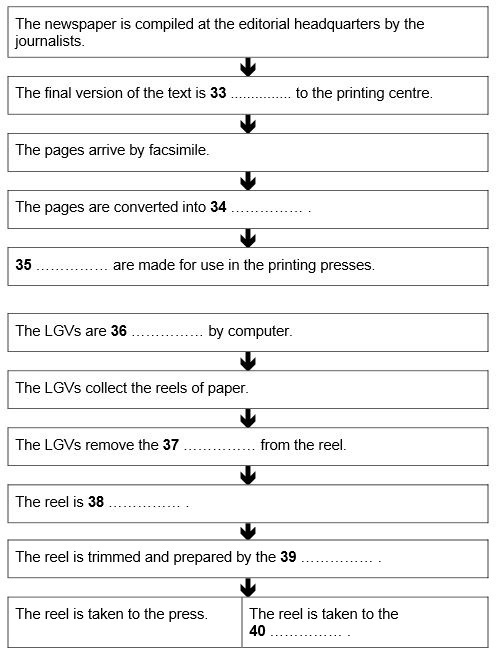
Once the finished newspaper has been created for the next morning’s edition, all the pages are transmitted electronically from the prepress centre to the printing centre. The system of transmission is an update on the sophisticated page facsimile system already in use in many other newspapers. An imagesetter at the printing centre delivers the pages as films. Each page takes less than a minute to produce, although for colour pages four versions, once each for black, cyan, magenta and yellow are sent. The pages are then  processed into photographic negatives and the film is used to produce aluminium printing plates ready for the presses.

C
A procession of automated vehicles is busy at the new printing centre where the Sydney Morning Herald is printed each day. With lights flashing and warning horns honking, the robots (to give them their correct name, the LGVs or laser guided vehicles) look for all the world like enthusiastic machines from a science fiction movie, as they follow their own random paths around the plant busily getting on with their jobs. Automation of this kind is now standard in all modern newspaper plants. The robots can detect unauthorised personnel and alert security staff immediately if they find an “intruder”; not surprisingly, tall tales are already being told about the machines starting to take on personalities of their own.

D
The robots’ principal job, however, is to shift the newsprint (the printing paper) that arrives at the plant in huge reels and emerges at the other end sometime later as newspapers. Once the size of the day’s paper and the publishing order are determined at head office, the information is punched into the computer and the LGVs are programmed to go about their work. The LGVs collect the appropriate size paper reels and take them where they have to go. When the press needs another reel its computer alerts the LGV system. The Sydney LGVs move busily around the press room fulfilling their two key functions to collect reels of newsprint either from the reel stripping stations or from the racked supplies in the newsprint storage area. At the stripping station, the tough wrapping that helps to protect a reel of paper from rough handling is removed. Any damaged paper is peeled off and the reel is then weighed.
E
Then one of the four paster-robots moves in. Specifically designed for the job, it trims the paper neatly and prepares the reel for the press. If required the reel can be loaded directly onto the press; if not needed immediately, an LGV takes it to the storage area. When the press computer calls for a reel, an LGV takes it to the reel loading area of the presses. It lifts the reel into the loading position and places it in the correct spot with complete accuracy. As each reel is used up, the press drops the heavy cardboard core into a waste bin. When the bin is full, another LGV collects it and deposits the cores into a shredder for recycling.

F
The LGVs move at walking speed. Should anyone step in front of one or get too close, sensors stop the vehicle until the path is clear. The company has chosen a laser guide function system for the vehicles because, as the project development manager says “The beauty of it is that if you want to change the routes, you can work out a new route on your computer and lay it down for them to follow”. When an LGV’s batteries run low, it will take itself offline and go to the nearest battery maintenance point for replacement batteries. And all this is achieved with absolute minimum human input and a much reduced risk of injury to people working in the printing centres.
G
The question newspaper workers must now ask, however, is, “how long will it be before the robots are writing the newspapers as well as running the printing centre, churning out the latest edition every morning?”

Questions 33 - 40

Using the information in the passage, complete the flow-chart below.
Write your answers in boxes 33-40 on your answer sheet.
Choose NO MORE THAN THREE WORDS from the passage for each answer.

The Production Process

GT Reading Test 3 Section 3 - Robots at work
Answer:
27. v
28. vii
29. iv
30. i
31. viii
32. iii
33. transmitted (NOT sent) (electronically)
34. (photographic) film// negative(s)
35. (aluminium) printing plates
36. programmed
37. (tough) wrapping // damaged paper
38. weighed
39. paster robot(s)
40. storage area

Contributors

Nature Beauty | Water | Road | River