Tuesday, 3 September 2019

IELTS Reading 03-09-2019: Reading Passage 3 (Academic)

You should spend about 20 minutes on Questions 29-40 which are based on the Reading Passage below.

 THE SCIENTIFIC METHOD

A ‘Hypotheses,’ said Medawar in 1964, are imaginative and inspirational in character’; they are ‘adventures of the mind’. He was arguing in favour of the position taken by Karl Popper in The Logic of Scientific Discovery (1972, 3rd edition) that the nature of scientific method is hypothetico-deductive and not, as is generally believed, inductive.

B It is essential that you, as an intending researcher, understand the difference between these two interpretations of the research process so that you do not become discouraged or begin to suffer from a feeling of ‘cheating’ or not going about it the right way.

C The myth of scientific method is that it is inductive: that the formulation of scientific theory starts with the basic, raw evidence of the senses - simple, unbiased, unprejudiced observation. Out of these sensory data - commonly referred to as ‘facts’ — generalisations will form. The myth is that from a disorderly array of factual information an orderly, relevant theory will somehow emerge. However, the starting point of induction is an impossible one.

D  There is no such thing as an unbiased observation. Every act of observation we make is a function of what we have seen or otherwise experienced in the past. All scientific work of an experimental or exploratory nature starts with some expectation about the outcome. This expectation is a hypothesis. Hypotheses provide the initiative and incentive for the inquiry and influence the method. It is in the light of an expectation that some observations are held to be relevant and some irrelevant, that one methodology is chosen and others discarded, that some experiments are conducted and others are not. Where is, your naive, pure and objective researcher now?

E Hypotheses arise by guesswork, or by inspiration, but having been formulated they can and must be tested rigorously, using the appropriate methodology. If the predictions you make as a result of deducing certain consequences from your hypothesis are not shown to be correct then you discard or modify your hypothesis.If the predictions turn out to be correct then your hypothesis has been supported and may be retained until such time as some further test shows it not to be correct. Once you have arrived at your hypothesis, which is a product of your imagination, you then proceed to a strictly logical and rigorous process, based upon deductive argument — hence the term ‘hypothetico-deductive’.

F So don’t worry if you have some idea of what your results will tell you before you even begin to collect data; there are no scientists in existence who really wait until they have all the evidence in front of them before they try to work out what it might possibly mean. The closest we ever get to this situation is when something happens by accident; but even then the researcher has to formulate a hypothesis to be tested before being sure that, for example, a mould might prove to be a successful antidote to bacterial infection.

G The myth of scientific method is not only that it is inductive (which we have seen is incorrect) but also that the hypothetico-deductive method proceeds in a step-by-step, inevitable fashion. The hypothetico-deductive method describes the logical approach to much research work, but it does not describe the psychological behaviour that brings it about. This is much more holistic — involving guesses, reworkings, corrections, blind alleys and above all inspiration, in the deductive as well as the hypothetic component -than is immediately apparent from reading the final thesis or published papers. These have been, quite properly, organised into a more serial, logical order so that the worth of the output may be evaluated independently of the behavioural processes by which it was obtained. It is the difference, for example between the academic papers with which Crick and Watson demonstrated the structure of the DNA molecule and the fascinating book The Double Helix in which Watson (1968) described how they did it. From this point of view, ‘scientific method’ may more usefully be thought of as a way of writing up research rather than as a way of carrying it out.
Questions 29-30
Reading Passage 12 has seven paragraphs A-G.
Choose the most suitable headings for paragraphs C-G from the list of headings below.
Write the appropriate numbers i-x in boxes 29-33 on your answer sheet.
List of Headings
iThe Crick and Watson approach to research
iiAntidotes to bacterial infection
iiiThe testing of hypotheses
ivExplaining the inductive method
vAnticipating results before data is collected
viHow research is done and how it is reported
viiThe role of hypotheses in scientific research
viiiDeducing the consequences of hypotheses
ixKarl Popper’s claim that the scientific method is hypothetico-deductive
xThe unbiased researcher
Example     Paragraph A            Answer: ix
29Paragraph C
30Paragraph D
31Paragraph E
32Paragraph F
33Paragraph G
Questions 34 and 35
In which TWO paragraphs in Reading Passage12 does the writer give advice directly to the reader?
Write the TWO appropriate letters (A—G) in boxes 34 and 35 on your answer sheet.
Questions 36-39
Do the following statements reflect the opinions of the writer in Reading Passage 12?
In boxes 36-39 on your answer sheet write
YES if the statement reflects the opinion of the writer.
NO  if the statement contradicts the opinion of the writer.
NOT GIVEN  if it is impossible to say what the writer thinks about this
36 Popper says that the scientific method is hypothetico-deductive.
37 If a prediction based on a hypothesis is fulfilled, then the hypothesis is confirmed as true.
38 Many people carry out research in a mistaken way.
39 The ‘scientific method’ is more a way of describing research than a way of doing it.
Question 40
Choose the appropriate letter A-D and write it in box 40 on your answer sheet.
Which of the following statements best describes the writer’s main purpose in Reading Passage 3?
A  to advise Ph.D students not to cheat while carrying out research.
B  to encourage Ph.D students to work by guesswork and inspiration.
C  to explain to Ph.D students the logic which the scientific research paper follows.
D  to help Ph.D students by explaining different conceptions of the research process.
Answer:
29.  iv
30.  vii
31.  iii
32.  v
33.  vi
34.  B
35.  F
36.  YES
37.  No
38.  NOT GIVEN
39.  YES
40.  D

IELTS Reading 03-09-2019: Reading Passage 1 (Academic)

You should spend about 20 minutes on Questions 1-13 which are based on Reading Passage 10 below.

ABSENTEEISM IN NURSING:A LONGITUDINAL STUDY

Absence from work is a costly and disruptive problem for any organisation. The cost of absenteeism in Australia has been put at 1.8 million hours per day or $1400 million annually. The study reported here was conducted in the Prince William Hospital in Brisbane, Australia, where, prior to this time, few active steps had been taken to measure, understand or manage the occurrence of absenteeism.

Nursing Absenteeism
A prevalent attitude amongst many nurses in the group selected for study was that there was no reward or recognition for not utilising the paid sick leave entitlement allowed them in their employment conditions. Therefore, they believed they may as well take the days off — sick or otherwise. Similar attitudes have been noted by James (1989), who noted that sick leave is seen by many workers as a right, like annual holiday leave.
Miller and Norton (1986), in their survey of 865 nursing personnel, found that 73 percent felt they should be rewarded for not taking sick leave because some employees always used their sick leave. Further, 67 per cent of nurses felt that administration was not sympathetic to the problems shift work causes to employees' personal and social lives. Only 53 percent of the respondents felt that every effort was made to schedule staff fairly.
In another longitudinal study of nurses working in two Canadian hospitals, Hacket Bycio and Guion (1989) examined the reasons why nurses took absence from work. The most frequent reason stated for absence was minor illness to self. Other causes, in decreasing order of frequency, were illness in family, family social function, work to do at home and bereavement.
Method
In an attempt to reduce the level of absenteeism amongst the 250 Registered an Enrolled Nurses in the present study, the Prince William management introduced three different, yet potentially complementary, strategies over 18 months. Strategy 1: Non-financial (material) incentives : Within the established wage and salary system it was not possible to use hospital funds to support this strategy. However, it was possible to secure incentives from local businesses, including free passes to entertainment parks, theatres, restaurants, etc. At the end of each roster period, the ward with the lowest absence rate would win the prize. Strategy 2 Flexible fair rostering: Where possible, staff were given the opportunity to determine their working schedule within the limits of clinical needs. Strategy 3: Individual absenteeism : and Each month, managers would analyse the pattern of absence of staff with excessive sick leave (greater than ten days per year for full-time employees). Characteristic patterns of potential 'voluntary absenteeism' such as absence before and after days off, excessive weekend and night duty absence and multiple single days off were communicated to all ward nurses and then, as necessary, followed up by action.
Results
Absence rates for the six months prior to the Incentive scheme ranged from 3.69 per cent to 4.32 per cent. In the following six months, they ranged between 2.87 percent and 3.96 percent. This represents a 20 percent improvement. However, analysing the absence rates on a year-to-year basis, the overall absence rate was 3.60 percent in the first year and 3.43 percent in the following year. This represents a 5 percent decrease from the first to the second year of the study. A significant decrease in absence over the two-year period could not be demonstrated.

Discussion
The non-financial incentive scheme did appear to assist in controlling absenteeism in the short term. As the scheme progressed it became harder to secure prizes and this contributed to the program's losing momentum and finally ceasing. There were mixed results across wards as well. For example, in wards with staff members who had a long-term genuine illness, there was little chance of winning, and to some extent, the staffs on those wards were disempowered. Our experience would suggest that the long-term effects of incentive awards on absenteeism are questionable.
Over the time of the study, staff were given a larger degree of control in their rosters. This led to significant improvements in communication between managers and staff. A similar effect was found from the implementation of the third strategy. Many of the nurses had not realised the impact their behaviour was having on the organisation and their colleagues but there were also staff members who felt that talking to them about their absenteeism was 'picking' on them and this usually had a negative effect on management—employee relationships.

Conclusion
Although there has been some decrease in absence rates, no single strategy or combination of strategies has had a significant impact on absenteeism per se. Notwithstanding the disappointing results, it is our contention that the strategies were not in vain. A shared ownership of absenteeism and a collaborative approach to problem solving has facilitated improved cooperation and communication between management and staff. It is our belief that this improvement alone, while not tangibly measurable, has increased the ability of management to manage the effects of absenteeism more effectively since this study.
[" This article has been adapted and condensed from the article by G. William and K. Slater (1996), 'Absenteeism in nursing: A longitudinal study', Asia Pacific Journal of Human Resources, 34(1): 111-21. Names and other details have been changed and report findings may have been given a different emphasis from the original. We are grateful to the authors and Asia Pacific Journal of Human Resources for allowing us to use the material in this way.  " ]

Questions 1-7
Do the following statements agree with the information given in Reading Passage.
In boxes 1-7 on your answer sheet write:
YES             if the statement agrees with the information
NO              if the statement contradicts the information
NOT GIVEN  if there is no information on this in the passage
1. The Prince William Hospital has been trying to reduce absenteeism amongst nurses for many years.
2. Nurses in the Prince William Hospital study believed that there were benefits in taking as little sick leave as possible.
3. Just over half the nurses in the 1986 study believed that management understood the effects that shift work had on them.
4. The Canadian study found that 'illness in the family' was a greater cause of absenteeism than 'work to do at home'.
5. In relation to management attitude to absenteeism the study at the Prince William Hospital found similar results to the two 1989 studies.
6. The study at the Prince William Hospital aimed to find out the causes of absenteeism amongst 250 nurses.
7. The study at the Prince William Hospital involved changes in management practices.
Questions 8-13
Complete the notes below.
Choose ONE OR TWO WORDS from the passage, for each answer.
Write your answers in boxes 8-13 on your answer sheet.
In the first strategy, wards with the lowest absenteeism in different periods would win prizes donated by ....... (8) .......
In the second strategy, staff were given more control over their ......(9 )........
In the third strategy, nurses who appeared to be taking ...... (10)...... sick leave or ...... (11) ...... were identified and counselled.
Initially, there was a ...... (12)...... per cent decrease in absenteeism.
The first strategy was considered ineffective and stopped.
The second and third strategies generally resulted in better ...... (13) ...... among staff.
Answer:
1. NO   2. NO   3. NO   4. YES   5. NOTGIVEN   6. NO   7. YES   8. (local) busunesses   9.(work/working) schedule/ rostering/ roster(s)   10. excessive   11. voluntary absence / absenteeism   12. twenty /  20   13. communication

Monday, 2 September 2019

How to Write 7+ bands Essay


IELTS Reading 02-09-2019: Reading Passage 3 (General)

The Penny Black


Read the text below and answer Questions 28-40.

The Penny Black

It might not have looked very impressive, but the Penny Black, now 170 years old, was the first stamp to be created and it launched the modem postal system in Britain.

Before 1840 and the arrival of the Penny Black, you had to be rich and patient to use the Royal Mail. Delivery was charged according to the miles travelled and the number of sheets of paper used; a 2-page letter sent from Edinburgh to London, for example, would have cost 2 shillings, or more than £7 in today’s money. And when the top-hatted letter carrier came to deliver it, it was the recipient who had to pay for the postage. Letter writers employed various ruses to reduce the cost, doing everything possible to cram more words onto a page. Nobody bothered with heavy envelopes; instead, letters would be folded and sealed with wax. You then had to find a post office - there were no pillar boxes - and hope your addressee didn't live in one of the several rural areas which were not served by the system. If you were lucky, your letter would arrive (it could take days) without being read or censored.

The state of mail had been causing concern throughout the 1830s, but it was Rowland Hill, an inventor, teacher and social reformer from Kidderminster, who proposed a workable plan for change. Worried that a dysfunctional, costly service would stifle communication just as Britain was in the swing of its second industrial revolution, he believed reform would ease the distribution of ideas and stimulate trade and business, delivering the same promise as the new railways.

Hill’s proposal for the penny post, which meant any letter weighing less than half an ounce (14 grams) could be sent anywhere in Britain for about 30p in today’s money, was so radical that the Postmaster General, Lord Lichfield, said, 'Of all the wild and visionary schemes which I ever heard of, it is the most extravagant.’ Lord Lichfield spoke for an establishment not convinced of the need for poor people to post anything. But merchants and reformers backed Hill. Soon the government told him to make his scheme work. And that meant inventing a new type of currency.

Hill quickly settled on 'a bit of paper covered at the back with a glutinous wash which the user might, by applying a little moisture, attach to the back of a letter’. Stamps would be printed in sheets of 240 that could be cut using scissors or a knife. Perforations would not arrive until 1854. The idea stuck, and in August 1839 the Treasury launched a design competition open to ‘all artists, men of science and the public in general’. The new stamp would need to be resistant to forgery, and so it was a submission by one Mr Cheverton that Hill used as the basis for one of the most striking designs in history. Cheverton, who worked as a sculptor and an engineer, determined that a portrait of Queen Victoria, engraved for a commemorative coin when she was a 15-year-old princess, was detailed enough to make copying difficult, and recognisable enough to make fakes easy to spot. The words ‘Postage’ and ‘One Penny’ were added alongside flourishes and ornamental stars. Nobody thought to add the word ‘Britain’, as it was assumed that the stamps would solely be put to domestic use.


With the introduction of the new postal system, the Penny Black was an instant hit, and printers struggled to meet demand. By the end of 1840, more than 160 million letters had been sent - more than double the previous year. It created more work for the post office, whose reform continued with the introduction of red letter boxes, new branches and more frequent deliveries, even to the remotest address, but its lasting impact on society was more remarkable.

Hill and his supporters rightly predicted that cheaper post would improve the ‘diffusion of knowledge’. Suddenly, someone in Scotland could be reached by someone in London within a day or two. And as literacy improved, sections of society that had been disenfranchised found a voice.

Tristram Hunt, an historian, values the ‘flourishing of correspondence’ that followed the arrival of stamps. ‘While I was writing my biography of Friedrich Engels I could read the letters he and Marx sent between Manchester and London,’ he says. ‘They wrote to each other three times a day, pinging ideas back and forth so that you can almost follow a real-time correspondence.’

The penny post also changed the nature of the letter. Weight-saving tricks such as cross-writing began to die out, while the arrival of envelopes built confidence among correspondents that mail would not be stolen or read. And so people wrote more private things - politically or commercially sensitive information or love letters. ‘In the early days of the penny post, there was still concern about theft,’ Hunt says. ‘Engels would still send Marx money by ripping up five-pound notes and sending the pieces in different letters.’ But the probity of the postal system became a great thing and it came to be expected that your mail would not be tampered with.


For all its brilliance, the Penny Black was technically a failure. At first, post offices used red ink to cancel stamps so that they could not be used again. But the ink could be removed. When in 1842, it was determined that black ink would be more robust, the colour of the Penny Black became a sort of browny red, but Hill’s brainchild had made its mark.

Questions 28-30

Choose the correct letter, A, B, C or D.

Write the correct letter in boxes 28-30 on your answer sheet.

28. One of the characteristics of the postal service before the 1840s was that

    A. postmen were employed by various organisations.
    B. letters were restricted to a certain length.
    C. distance affected the price of postage.
    D. the price of delivery kept going up.

29. Letter writers in the 1830s

    A. were not responsible for the cost of delivery.
    B. tried to fit more than one letter into an envelope.
    C. could only send letters to people living in cities.
    D. knew all letters were automatically read by postal staff.

30. What does the text say about Hill in the 1830s?

    A. He was the first person to express concern about the postal system.
    B. He considered it would be more efficient for mail to be delivered by rail.

    C. He felt that postal service reform was necessary for commercial development.
    D. His plan received support from all the important figures of the day.

Questions 31-34

Look at the following statements (Questions 31-34) and the list of people below.

Match each statement with the correct person, A, B , C or D.

Write the correct letter, A, B, C or D, in boxes 31-34 on your answer sheet.

NB You may use any letter more than once.

31. His inspiration came from a particular picture.
32. He claimed that the postal system would lead to the spread of information.
33. He organised the creation of the first stamp.
34. He expressed doubts about the plans to change the postal service.

List of People

A.  Rowland Hill
B.  Lord Lichfield
C.  Cheverton
D.  Tristram Hunt

Questions 35-40

Complete the notes below.

Choose NO MORE THAN TWO WORDS from the passage for each answer.

Write your answers in boxes 35-40 on your answer sheet.
The Penny Black
• Design came about as a result of a competition organised by the 35 ........................

• Based on an engraving of Queen Victoria featured on a 36 .........................

• Apart from the Queen’s face, the stamp had just three words and pictures of 37......................... as decoration

• No mention of 38......................... as plan was for stamps to be for domestic use only

• The 39........................., which was applied to indicate that the stamp had been used, proved to be ineffective

• In 1842, the 40......................... of the stamp was changed.
 Answer:
28. C
29. A
30. C
31. C
32. A
33. A
34. B
35. Treasury
36. (commemorative) coin
37. (ornamental) stars
38. (word) Britain
39. (red) ink
40. colour// color
(Note: Words in brackets are optional - they are correct, but not necessary.)

IELTS Reading 02-09-2019: Reading Passage 2 (General)

The benefits of having a business mentor &

A Planning Process for Middle-Sized Projects


Read the text below and answer Questions 15-20.

The benefits of having a business mentor

Introduction:
If you're starting your own business, you probably need a mentor. This is a business person who volunteers to give their time to help somebody else with their work - particularly somebody who is new to the business. They have a wealth of experience they are willing to share, perhaps from setting up and running their own company. The mentor's role is to support, develop, stimulate and challenge. However, business mentors won't solve your problems for you or tell you what to do: they will talk things over with you, rather than acting as consultants. Many people while setting up their first business have found that a mentor can have a very positive effect on its success.

Why business mentoring is important:
If you have a gap in your knowledge or experience, then mentoring could work very well for you. For example, you may have a great concept for a business but need a bit of assistance to turn it into a successful venture.

A mentor can provide you with a number of benefits, such as:

• guidance on developing and improving your business
• help with decisions - particularly difficult ones
• ideas for new products or services, or for working practices that will improve your efficiency
• tips for your business that are gained from practical experience
• access to a network of contacts with other business people

A business mentor can also help you to:

• develop key business skills
• improve your problem-solving abilities
• build confidence
• work on your personal development

Face-to-face business mentoring:
If you decide that face-to-face business mentoring is right for you, mentor and mentee should decide in advance on the nature of the relationship.

You will need to agree on the degree of involvement that suits you both. Some mentors and mentees work extremely closely, keeping in touch with each other most weeks or even most days. In the majority of cases, however, a mentor will provide help every few weeks or months. In either case, they might meet, speak on the phone, or exchange emails.


You should also agree on a level of structure to suit you both. Mentoring can be a very formal process with regular meetings which follow a specific agenda and work towards a specific set of goals. It can also be quite a casual arrangement, where the mentee calls on the mentor as and when problems or questions arise.

Questions 15-20

Complete the notes below.

Choose ONE WORD ONLY from the text for each answer.

Write your answers in boxes 15-20 on your answer sheet.

How can a mentor help somebody setting up a business?

A mentor 15............................. to help a new business person.

Mentors have a different role from 16 ............................. .

A mentor can: 

• help you turn your idea into a successful business
• assist when you need to make 17............................. .

• suggest how your business can increase its 18 ............................. .
• introduce you to a business network
• help you to develop your skills, abilities and provide you with more 19 ............................. .

To be agreed: 

• how much 20 .............................  the mentor should have

• how much structure the mentoring process should have.


Read the text below and answer Questions 21-27.

A Planning Process for Middle-Sized Projects

Any business project - such as reducing energy costs, or improving efficiency - needs to be planned, and time spent planning will save far more time later on.

The typical stages in this planning process are explained below.
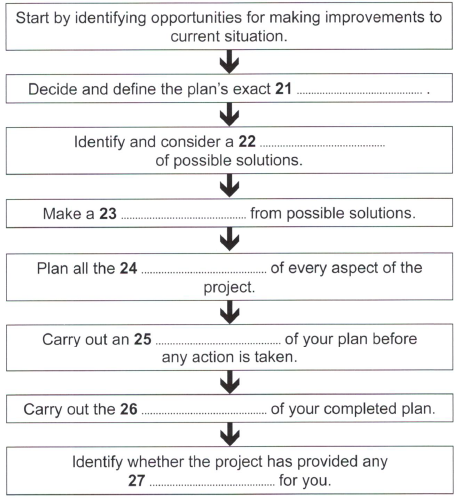
  • Your first task is to spot what needs to be done. Examine your firm’s current position, perhaps making a formal analysis of its strengths and weaknesses. Then think about how you might improve that position: what opportunities are there for achieving this?
  • The next step is to decide precisely what the aim of your plan is. This is best expressed in a simple single sentence, to ensure that it is clear and sharp in your mind. Doing this helps you to avoid wasting effort on irrelevant side issues.
  • Next you should work out how to do it. It is tempting just to grasp the first idea that comes to mind, but it is better to consider a wide range of options: this way, you may come up with less obvious but better solutions.
  • Once you have explored the options available to you, the selection of which option to use is the next step. If you have the time and resources, you might decide to evaluate all options, carrying out some planning, such as costing, for each. Normally you will not have this luxury.
  • You already have a broad idea of what your project will consist of. Now is the time to work out the full details, identifying the most efficient and effective method of carrying it out, including answering the questions of ‘who’, ‘what’ and ‘when’.
  • The next stage is to review your plan and decide whether it will work satisfactorily. This evaluation enables you to change to another option that might be more successful, or to accept that no plan is needed.
  • Once you have finished your plan and decided that it will work satisfactorily, it is time for implementation. Your plan will cover how this is to be done.
  • Once you have achieved a plan, you can close the project. At this point, it is often worth assessing the project to see whether there are any lessons that you can learn.
     

Questions 21-27

Complete the flow-chart below.

Choose ONE WORD ONLY from the text for each answer.

Write your answers in boxes 21-27 on your answer sheet.

Suggested stages in a planning process

Image- Stages in a planning processImage- Stages in a planning process
 Answer:
15. volunteers
16. consultants
17. decisions
18. efficiency
19. confidence
20. involvement
21. aim
22. range
23. selection
24. details
25. evaluation
26. implementation
27. lessons

IELTS Reading 02-09-2019: Reading Passage 1 (General)

Some places to visit & LearnWithUs courses


Read the text below and answer Questions 1-8.

Some places to visit

A    Beautiful Kingsley House was built in the 18th century, and all the rooms are decorated and furnished in the style of the time. They include the dining room, study and dressing room, which contains a display of 18th-century ladies’ clothing. Our volunteer guides in each room bring the house to life with stories of the past.

B    The Africa Museum was founded 50 years ago, and to commemorate the event, we have chosen 50 treasures from the permanent collection and put them together to tell the fascinating story of that continent. This exhibition continues until the end of the year. The Folk Art Gallery opens to the public next month, exhibiting traditional paintings and other objects from all over Africa.

C    From the outside, 17 Mansfield Street may not look particularly exciting, but come inside, and you’ll find yourself in a historic building that started life as a theatre, before becoming a bank and then a restaurant, which is still in operation. On
Sundays and Mondays, when the restaurant is closed, a guide is available to show you round the building and its fascinating architectural features.

D    The Industrial Heritage Centre tells the fascinating story of a local family firm. Mr John Carroll started his engineering business in this building exactly 150 years ago. The firm closed in 1969, but the factory has been re-created, with machines like those that Mr Carroll was familiar with. See what working life could be like in the 19th century, a life far removed from the elegance of the wealthy.

E    The Fashion Museum has only just opened. It is home to an outstanding collection of more than 30,000 objects worn by men, women and children, dating from the 17th century to the present day. You’ll see how people used to dress! As well as
the permanent exhibits, you can currently see Dressing the Stars, which displays original costumes worn by the stars of many popular films.

F     Having spent the best part of two years being refurbished, the Mason Museum has recently opened its doors again. It provides a magnificent setting for its art collection and for the beautiful 18th-century furniture for which the Mason is famous. Open Mondays to Fridays 10-4, and weekends 10-6.

Questions 1-8

The text above has six descriptions of places to visit in the same city, A-F.

Which description mentions the following information?


Write the correct letter A-F, in boxes 1-8 on your answer sheet.

NB You may use any letter more than once.

1. clothes that well-known people have worn
2. a display that cannot be seen yet
3. people who talk in an entertaining way
4. the museum having just reopened
5. a building that has changed its function several times
6. furniture of the same kind that was used when the building was new
7. being open for tours on certain days of the week
8. a special event to mark an anniversary


Read the text below and answer Questions 9-14.

LearnWithUs courses

LearnWithlls courses are a great way to learn, because they’re so flexible. All our courses are taken online using a computer, so you can work through the course at your own speed, and go back to any session whenever you want to. For some courses there are workbooks, in addition to the computer course, to provide extra written practice.

We offer hundreds of courses in a whole range of subjects from reading, writing and maths to business and management. Many of these are specially designed for people whose first language isn’t English.

Step one: have a chat with a friendly member of staff in one of our 1,500 LearnWithUs centres around the country. They can advise you on the most suitable course. They’ll also work out whether you qualify for funding, so that you won’t have to pay the full fee for the course.

You might want to try a taster lesson first. This is a single computer session in any subject of your choice, and it will show you what learning with LearnWithUs is like.

When you’ve made your final decision, step two is to register on your course. Once you’ve done this, a staff member will show you how to get started, whether you’re using a computer at home, at work or at a LearnWithUs centre.

That’s all you need to do! When you start your course, you can contact your LearnWithUs centre by phone (we’re open during normal office hours) or email if you need help.

Questions 9-14

Do the following statements agree with the information given in the text above?

In boxes 9-14 on your answer sheet, write

TRUE   if the statement agrees with the information
FALSE   if the statement contradicts the information
NOT GIVEN   if there is no information on this

9. You can work through parts of a course more than once.
10. The number of courses offered by LearnWithUs has increased enormously.
11. Many staff members have worked through a LearnWithUs course themselves.
12. You may have to pay to take a LearnWithUs course.
13. Everybody takes the same taster lesson.
14. LearnWithUs centres are open seven days a week.
 Answer:
1. E
2. B
3. A
4. F
5. C
6. A
7. C
8. B
9. TRUE
10. NOT GIVEN
11. NOT GIVEN
12. TRUE
13. FALSE
14. FALSE

IELTS Reading 02-09-2019: Reading Passage 3 (Academic)

You should spend about 20 minutes on Questions 30-41 which are based on the Reading Passage below.

PAPER RECYCLING

A Paper is different from other waste produce because it comes from a sustainable resource: trees. Unlike the minerals and oil used to make plastics and metals, trees are replaceable. Paper is also biodegradable, so it does not pose as much threat to the environment when it is discarded. While 45 out of every 100 tonnes of wood fibre used to make paper in Australia comes from waste paper, the rest comes directly from virgin fibre from forests and plantations. By world standards, this is a good performance since the worldwide average is 33 percent waste paper. Governments have encouraged waste paper collection and sorting schemes and at the same time, the paper industry has responded by developing new recycling technologies that have paved the way for even greater utilization of used fibre. As a result, industry’s use of recycled fibres is expected to increase at twice the rate of virgin fibre over the coming years.
B Already, waste paper constitutes 70% of paper used for packaging and advances in the technology required to remove ink from the paper have allowed a higher recycled content in newsprint and writing paper. To achieve the benefits of recycling, the community must also contribute. We need to accept a change in the quality of paper products; for example, stationery may be less white and of a rougher texture. There also needs to support from the community for waste paper collection programs. Not only do we need to make the paper available to collectors but it also needs to be separated into different types and sorted from contaminants such as staples, paperclips, string and other miscellaneous items.
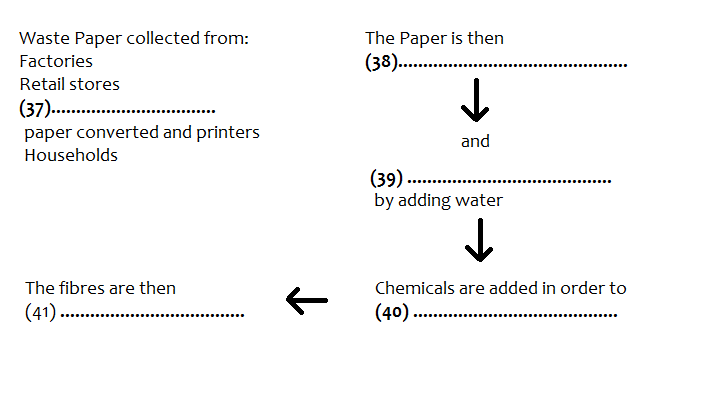
C There are technical limitations to the amount of paper which can be recycled and some paper products cannot be collected for re-use. These include paper in the form of books and permanent records, photographic paper and paper which is badly contaminated. The four most common sources of paper for recycling are factories and retail stores which gather large amounts of packaging material in which goods are delivered, also offices which have unwanted business documents and computer output, paper converters and printers and lastly households which discard newspapers and packaging material. The paper manufacturer pays a price for the paper and may also incur the collection cost.
D Once collected, the paper has to be sorted by hand by people trained to recognise various types of paper. This is necessary because some types of paper can only be made from particular kinds of recycled fibre. The sorted paper then has to be repulped or mixed with water and broken down into its individual fibres. This mixture is called stock and may contain a wide variety of contaminating materials, particularly if it is made from mixed waste paper which has had little sorting. Various machineries are used to remove other materials from the stock. After passing through the repulping process, the fibres from printed waste paper are grey in colour because the printing ink has soaked into the individual fibres. This recycled material can only be used in products where the grey colour does not matter, such as cardboard boxes but if the grey colour is not acceptable, the fibres must be de-inked. This involves adding chemicals such as caustic soda or other alkalis, soaps and detergents, water-hardening agents such as calcium chloride, frothing agents and bleaching agents. Before the recycled fibres can be made into paper they must be refined or treated in such a way that they bond together.
E Most paper products must contain some virgin fibre as well as recycled fibres and unlike glass, paper cannot be recycled indefinitely. Most paper is down-cycled which means that a product made from recycled paper is of an inferior quality to the original paper. Recycling paper is beneficial in that it saves some of the energy, labour and capital that go into producing virgin pulp. However, recycling requires the use of fossil fuel, a non-renewable energy source, to collect the waste paper from the community and to process it to produce new paper. And the recycling process still creates emissions which require treatment before they can be disposed of safely. Nevertheless, paper recycling is an important economical and environmental practice but one which must be carried out in a rational and viable manner for it to be useful to both industry and the community.
Questions 30-36
Complete the summary below of the first two paragraphs of the Reading Passage.
Choose ONE OR TWO WORDS from the Reading Passage for each answer.
Write your answers in boxes 30-36 on your answer sheet.
SUMMARY
Example ....
From the point of view of recycling, paper has two advantages over minerals and ...........oil..........
in that firstly it comes from a resource which is ........ (30) ........ and secondly, it is less threatening to our environment when we throw it away because it is ....... (31) ...... Although Australia’s record in the re-use of waste paper is good, it is still necessary to use a combination of recycled fibre and ........ (32) ........ to make new paper. The paper industry has contributed positively and people have also been encouraged by .........(33) ......... to collect their waste on a regular basis. One major difficulty is the removal of ink from used paper but ......... (34) ......... are being made in this area. However, we need to learn to accept paper which is generally of a lower ......... (35) ......... than before and to sort our waste paper by removing ......... (36) ........ before discarding it for collection.
Look at paragraphs C, D, and E and, using the information in the passage, complete the flow chart below. Write your answers in boxes 37-41 on your answer sheet. Use ONE OR TWO WORDS for each answer.

IELTS Academic reading sample 9
Answer:
30.     sustamable  31.     biodegradable    32.     virgin fibre/ pulp   33.     governments/ the government    34.     advances   35.     quality    36.     contaminants   37.     offices   38.     sorted    39.     (re)pulped   40.     de-ink/ remove ink/ make white   41.     refined
 

Contributors

Nature Beauty | Water | Road | River